Thursday, March 10, 2011

¡Ladron! 12/4/2010

So, to save ourselves some agony and trouble of hauling gear, we asked the caballero who frequents this little shanty house near our study site if we could use some space in the stable. He agreed, but what I have now realized is that this came with a price. Two tomahawks have gone missing, and now the scissors Tina lent me (so sorry, Tina!), along with some vials we were using to store samples, tape and I am sure something else that has no immediate consequence to our work, but will sorely be missed when I really need it... whatever it is.

Leaving the equipment in the field may be a better option, but I fear now that the Chilean mentality about some things might strip us down to nearly nothing by the last week if I am not careful. Little of the equipment I am using really belongs to me, so I am understandably worried about this. However, I carry the expensive, irreplaceable things back to the cabin with me each day, so we won’t be crippled if the tomahawk box disappears.

On a high note, I saw some Andean geese today, which was very cool. Pablo and I only trapped one coruro in Colony C (3), which was probably for the best because of the theft of our vials. It left some time for speaking Spanglish and getting to know Pablo, who kindly stepped in to take Claudia’s place. He completed his degree in Marine Biology at a university in Conceptión, the city closest to the epicenter of the earthquake this past February. Pablo showed me a typo in the field guide I’ve been using. The small wild cat that lives in the south of Chile is called by many names in the field guide 'A Wildlife Guide to Chile: Continental Chile, Chilean Antarctica, Easter Island, Juan Fernandez Archipelago', but the meaning of the primarily used name in the book means something different than is intended and is not the correct spelling. The actual name of the cat is guiña. I expect I should write a letter to the author, Sharon Chester, and let her know about the necessary change in the second edition.

Some personal reflection on the research also went on, which included some work on the mental ‘to do’ list. I find it hard to get much accomplished in the afternoons, as the hike back to the cabin tends to be rather exhausting, and chores, cooking and eating need to get done. It doesn’t leave much time for working on data analysis or keeping up with sample labels. It will kick me in the tush later, but maintaining my health is most important. I cannot afford to have the flu a third time this field season.

A Happy Thanksgiving

I believe this is the first Thanksgiving I’ve spent away from home.

I could certainly think of worse places to be than where I am now instead of home, but my mind keeps drifting back home as the days pass. At this time of year, my mind innately enters the holiday season mentality. I am certainly one for traditions and time spent with my family, bundled up under a blanket, with kitty cat lap warmers, watching a movie we’ve seen a hundred times, eating homemade cookies, surrounded by the decorum of Christmas. The house always smells so good, with hints of evergreen, cinnamon, and delicious homemade meals.

My mom has recorded festivities from each year. The albums are always out about at this time to revisit years passed. No matter where we were, we were together. I always try to make it home in time to help decorate the Christmas tree. Usually I have to come help bring it in from outside, too. However, I am finding it harder to be at home in time as each year passes and the further I move away for my studies. In the back of my mind, I keep thinking, ‘I hope that the Andes of Chile is as far away as I get’. I try not to be too nostalgic about not being home in time for the start of the holiday events: Thanksgiving, baking casseroles and sweets, eating casseroles and sweets, Black Friday, decorating the house for Christmas with Nat King Cole, Henry Conic Jr., and Bing Crosby playing in the background, Christmas Eve caroling-driving around looking at lights- around our neighborhood, and of course Christmas morning. I will be home just in time for Christmas (flying into SA-town on the 23rd), so I won’t miss the best parts.

Grand Canyon, Thanksgiving 2007

Nasrim and I have been working nonstop since Thursday, November 18, having splendid success, as we are already up to 16 individuals from 2 colonies after only 4 days of trapping. The weather has been fabulous, save for the one afternoon with hail, and we pass the time when we are not handling the animals watching distant herds of horses grazing, lizards racing and birds flying about us. The Andean condors pass overhead regularly. The beetles are usually in a hurry to get to nowhere. And all taking little interest in our presence, making for excellent photo op’s. The view really can’t be beat up here.

The road to Farillones

Nasrim and I took the holiday, Thanksgiving, off. Not only did we take it because I wanted to recognize the day, but we NEEDED it. We had downright exhausted ourselves hauling the gear back and forth, digging holes in the ground and working under an intense sun for 7 days. So, we slept in, then hiked down to the nearest town called Farillones, picked up some groceries (¡que carro!), and stopped for lunch at a pizzeria. We sat on the terrace which had an exceptional view and munched on our pizza while eavesdropping on the people behind us who were from Brazil and somewhere from Western Europe.

Pizza for Thanksgiving

After we filled our stomachs, we began our way back to the cabin. It only took ½ an hour to reach Farillones going down, but it took at least an hour getting back up to La Parva. We stopped several times to take advantage of the ‘miradores’.

Splendid views along the road

Just about near death, we finally reached the cabin, downed some water and flopped on the couch to watch a movie. Afterword, we hiked out to the field site, feeling the wear of the afternoon’s walk up the mountain, only to discover at least 30 people camped out on top of Colony B! We went and spoke to them. Well, Nasrim spoke and I just nodded when I understood and agreed with what they were saying. We discovered they were from a university in Santiago, studying eco-tourism. I was thrilled to learn that they would be leaving shortly after 9 am the next morning. I was certainly glad we had chosen to take the day off.

After an eventful day, we had a simple dinner of salad and pasta and then watched another movie before bed. As I turned in, I thought of my family and how much I wished I could just pick up the phone and call to tell them I was thinking of them.

Week 1 in the Andes of Chile

Five days into my study in the field near a small pueblo, La Parva. Well, it is more of a ski resort town turned ghost town as there is no snow, being springtime here in the southern hemisphere.

Springtime in the mountains

I feel as though I have lived here for ages. The time passes differently here in the Andes. Maybe it is because the weather changes so drastically every day, with bright, strong sunlight in the mornings and heavy clouds that literally fall upon you in the afternoon starting around 14:00. There are chilling crosswinds cutting across the plain during the day that become far more noticeable once the sun falls behind the clouds. You know the old Texas adage ‘if you don’t like the weather, wait 10 minutes and it will change’? Yep, it applies to here, too. Today, Nasrim and I had to cut it short because the clouds that stole the sun today were actually full of precipitation. Guess what it manifested itself as it fell on our heads? Hail. HAIL! As we rushed back to the cabin we were chased by thunder clouds that periodically lit up with lightning.

Two hours later the sun came out and erased any trace of the dime size clumps of cold, icy, evil that fell on our heads. For someone who really has no interest in being cold, snow, or anything associated with such things, I keep find myself in these conditions. However, we bore witness to a lovely sunset at about 20:30.

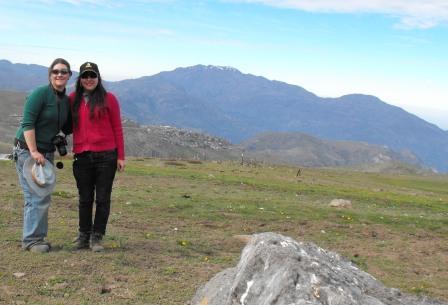
Nasrim, the saint who volunteered to be my field assistant for the first two weeks of my study, has taken everything in stride. She has been bit mercilessly by monster coruros (150 g, that’s big, trust me), moved heavy equipment with me up, suffered the blazing sun, tolerated the cold nights, and borne my terrible Spanish. We have taken turns cooking and every meal has been splendid.

Nasrim y yo

Nasrim en el campo con un coruro


To give you an idea of how cold it is here let me try to paint a picture for you. Nasrim and I are sitting in the living room, we are not using the gas heater because it uses too much gas and does little to warm the 3 bedroom, 2 bath cabin. After taking a hot shower, I find myself in sweatpants, wool socks, polypro thermal top (thanks Dad!), hoodie, and 2 blankets, my wool blanket (thanks Mom) and another. Nasrim is in two sweaters and is bundled up in the extra comforter. I am about to go put the kettle on for another round of Milo’s.

Our Cabin, second floor. Roughing it.

By field biologist standards I am living like a queen. We are an hour outside of Santiago. We have hot water, hot food, electricity, spacious accommodations, a mattress to sleep on, beautiful vistas to view every day out my window, and all this in close proximity to my field site. It is only a good ¾ mile hike to the land of milk and honey. Just over a couple hills, the land is pock marked with coruro burrows! Their activities are easy to monitor as they pop their head out of the ground constantly. They have little fear of people and you can get within a meter of them before they bolt underground again. It’s very much like Whack-a-Mole game. It is odd to me too because they respond to each other’s calling by also calling, unlike my other study site in Rinconada de Maipú. It is like living in surround sound. In the first two days of trapping, in just one colony, we have managed to capture 9 individuals, who have all had something to say…each having provided alarm calls sufficient for analysis.

Though I have been extremely focused on what I came here to do, I have taken the time to look up from the ground a time or two. The bird community is fascinating; most appear to be migrants, but I have seen some of the residents pass over us with brazen curiosity. On day 3 I stood in awe as 2 Andean Condors passed just over my head. Enormous, elusive, efficient scavengers were taking an interest in my activities in their part of the neighborhood. Gorgeous! Of course, I didn’t think to pull out my camera. When I finally went for it, I observed 5 condors riding a thermal high above my head, drifting away to the west.

The Andean Condor

I have also seen chincóles, Chilean swallows, tit-tyrants, cynclodes spp., sierra finches and a resident mountain caracara. This guy really doesn’t give us much notice.

The Mountain Caracara

I have also had the pleasure of encountering hissing beetles, rather largish tarantulas, wily lizards, and few biting ants that found their way into my pants. The flies have occasion to run into you with the crosswinds, but really we are not pestered by any of the residents.

Greenish Lizard

Tarantula

Tomorrow is Day 6 and we begin trapping at our second colony. I hope we have as much luck as the first two day, but I am already beginning to worry about my supplies lasting into our third week.

Hostel stays are the way to go!

I spent nearly 10 nights in La Chimba Hostel in Barrio Bellas Artes. Would I recommend this place to any backpacker? Yes. The people were nice, the hostel clean, and I always felt safe. The location is great for getting around on foot to see the touristy parts of the city. If you want to see more, the metro station is a 10 minute walk. The only thing… bring a pair of ear plugs or a charged ipod to drown out the snorers and the music from the karaoke bar next door. The receptionists are super helpful. They can call you a taxi, give you directions, have your clothes washed for you in a day for very little, and store your things without any hassle. Also, they have clean towels at no extra cost to you!

If I had to do it again, the only thing I would ask is to stay in female dorms. Sleeping in a room full of strange men each night can be a bit unnerving, though. Also, try to get a bottom bunk. For me this had consequences due to some childhood memories of falling out of top bunks. I was very conscious of how I was sleeping at night. Most importantly, this was also because the frame of my bed squeaked loudly whenever I moved. I found it to be a good tool to quell the snoring in our room. However, the first night I stayed in the dorm a guy from Brazil fell right out of the top bunk on the other side of the room in the middle of the night! I sat straight up in bed, “todo bien?!”. He assured everyone he was fine and went to get a drink of water. I hoped that helped him…

Something I also learned: Avoid telling people you are from Texas. If it has to come out, follow up with either, “I’m a democrat” or “I voted for Obama”. Otherwise, you will have to hear about how you are from the same state as Bush… And then the Bush jokes will start. If you are a Bush supporter, (1) Prepare a defense for your decision to support the man; (2) Go buy his first autobiography and please forget to tell me about it after you’ve read it.

I met some really awesome people while staying in La Chimba. They were from all over the world and were traveling for various reasons. Mostly, everyone was passing through. Santiago was just a stopping point. Many had been traveling for weeks through South America, working their way across, up, down, zigzag, across the continent. Some spoke only Spanish, and others spoke an outrageous number of languages that immediately put me to shame. The Brazilians spoke Portuguese, English and Spanish. Germans and Austrians were learning Spanish as they traveled. Australians and New Zealanders were winging it (disclaimer: not all). The Swedes one night found a vampire movie on cable in Swedish and took over the TV room.

In talking to these people, not only did I meet such a fascinating diversity of people whose lives were so different from mine, but I realized I was the one who could offer advice on the best places to visit in and around Santiago, the exchange rates, the best restaurants, museums and artisanal markets to hit up, what streets to take… it was a disturbing and thrilling revelation for me. I had lived in this city for 5 months!

I spent some time getting to know a gentleman who could be considered a resident by hostel standards. He was originally from Iran and had been living in England. He was on a journey which had taken him through Africa, China, Indonesia, Australia, New Zealand. He had somehow found himself in Chile for the time, but in no hurry to leave to anywhere in particular. It was insightful talking to him about his life and the emotional place he now found himself in.

I was a little sad to leave at the end of my stay. I would miss having such great conversations with new people from faraway places every night. However, I was ready to start the final chapter in my travels. And finally have a good night’s sleep. Into the Andes!!! It would certainly not be the last time I stayed in a hostel.